

With great excitement, the L3AF community unveils its third code release, Release 2.1.0. This release promises to be a game-changer in the networking and security domain, introducing a suite of enhancements, new features, and crucial bug fixes. In this post, we’ll delve into what’s new in L3AF Release 2.1.0 and explore how it stands to make a significant impact on the networking landscape.
The L3AF platform provides full lifecycle management for running ebpf programs at several hook points to defend against DDoS attacks, it offers deep visibility into network infrastructure, which are usually hidden outside of the Linux kernel, and enables complex functions to be performed directly in the traffic flow within the technology stack of Walmart’s retail and e-commerce platform.
L3AF Introduction, eBPF technology and Demo
- Presenter : @Ajay
- Presentation: Documents & Collateral – L3AF – Confluence
*This post originally published on medium as part of the Walmart Global Tech Blog, written by L3AF community member Karan Dalal.
Walmart Global Tech is developing some of the most cutting-edge products in the realm of eBPF under the Linux Foundation Networking (LFN) project, L3AF. Though this blog can be read independently, we recommend reading the three-part series introducing the L3AF project.
“The Traffic Mirroring eBPF package takes advantage of recent innovations in kernel engineering to provide a scalable, efficient, and distributed solution to mirror traffic of interest from a linux host to a destination of choice.”
With millions of people around the world shopping at Walmart, our platform engineers have developed the traffic mirroring (eBPF package) to optimize the customer experience, and to enable real-time, reliable network security.
It is essential for Walmart to have visibility into how the customers are interacting with our site. Similarly, we would also like to send traffic to out-of-band security and monitoring solutions for content inspection, threat monitoring and network debugging.
Today, we are open sourcing the traffic mirroring eBPF package, which seamlessly integrates with the L3AF eco-system to automate the process of sending the traffic of interest to a destination of choice.
Requirements for a traffic mirroring solution
One of the most effective ways of collecting this traffic of interest in the public cloud is from the edge proxy servers. However, it is also a critical hop that handles all the ingress traffic to the site and is performance sensitive.
Keeping this in mind, below is a high-level summary of the solution requirements:
- Lightweight, highly performant, and secure solution that can be implemented at the source (i.e., on the edge proxy)
- Software-based solution that can run on any commodity linux server, thereby eliminating an additional point of hardware failure, and saving on infrastructure cost.
- Customized filtering capability that allows us to mirror only traffic we care about to the analytics solution/s.
- Provide the flexibility to dynamically enable/disable the mirroring function with the ability to selectively choose the applications/domains that we want visibility into, on the fly, in a seamless manner.
Challenges with commercial solutions
Most of the commercial solutions are based on legacy networking stack and have several limitations. A few of these solutions are listed here:
- Running a stand-alone agent that would mirror 100% of traffic (on the edge proxy). However, this would incur significant traffic expenses as we would mirror 100% data. Additionally, we would also incur licensing cost ($ / NIC that we decide to mirror) and be an overhead on the resources of the host.
- Using traffic mirroring services that are offered natively by the public cloud. However, this isn’t a consistent solution as many flavors of the public cloud either do not offer this solution or do not offer the necessary capability to filter the data of interest.
Traffic Mirroring with eBPF
The traffic mirroring eBPF package encapsulates the filtering and mirroring functionalities together.
As seen in the diagram, it does the following:
- mirrors both the inbound and outbound traffic, from the attached host network interface/s
- filters the traffic of interest based on one or many custom filters in 5-tuple (sa, da, sp, dp, proto), thereby limiting the bandwidth utilization.
- sends the traffic of interest to the destination of choice.
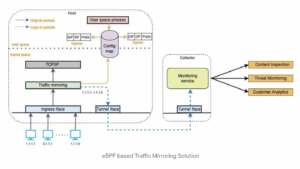
Additionally, given that eBPF is very lightweight, highly performant, and safe, this solution can be implemented at the source (i.e., on the edge proxy). So, on the edge proxy, we attach the mirroring function to the primary NIC that processes the actual traffic. This solution examines every incoming/outgoing packet using the TC hook and matches it against the filter (5-tuple based). If the match is successful, it clones the packet and redirects to a secondary NIC that forwards traffic to the analytics systems on a GUE tunnel.
Out of the box integration with L3AF eco-system
The L3AF eco-system enables enterprises to manage and orchestrate eBPF packages at scale. Using out-of-the box integration with L3AF, users can leverage simple APIs to:
- Launch the traffic mirroring program into the running kernel and monitor the health of the program.
- Run multiple eBPF programs in a chain (sequence) on an interface. For e.g., we can call an API to configure and run flow log exporter and traffic mirroring programs in a sequence. The API also allows us to change the sequence dynamically.
- Update the traffic mirroring filters on the fly. For e.g., we can call an API to update the port or protocol.
- Publish the health status in PromQL format, and integrate with alert manager
Try it!
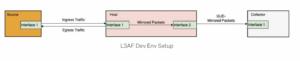
The L3AF dev environment is a virtual machine environment that allows users to develop, test, or just try out packages from the eBPF package repository. Detailed instructions on how to setup the L3AF development environment via Vagrant or on a standalone Linux machine/VM are available here. Once the development environment is setup, you can see that we use one host interface for the data plane and another host interface for forwarding the mirrored traffic. As mirrored packets are forwarded to the collector via GUE, we create a GUE tunnel both on the host’s “Interface 2” and collector’s “Interface 1”. This is also explained in the diagram above. To know more about how the GUE tunnel is setup, you can read the documentation here.
To orchestrate and compose the traffic mirroring program, we can either use the Swagger UI or HTTP POST request. This payload contains the configuration details of development environment (e.g., IP of the Collector’s Tunnel interface, Gateway IP, mirror ingress/egress traffic, etc.) and the traffic mirroring program’s filter parameters (e.g., only mirror TCP packets originating from a particular source IP and whose destination PORT is 8080).
Once traffic mirroring is loaded, you can observe the mirrored traffic via a packet capture on Collector’s “Interface 1” based on the traffic mirroring filter parameters specified. Alternatively, you can also observe the Grafana dashboard for Host’s “Interface 2” to monitor the metrics pertaining to mirrored packets.
The L3AF Project is in the early adoption phase, and we would like to welcome you to ask us questions on our GitHub repository — and contributions are always welcome!
This blog is written with inputs from Jay Sheth and Santhosh Fernandes, who are engineers on the L3AF Project at Walmart.
L3AF introduces a comprehensive UPF architecture with support for hooks through AF_XDP. This allows developers to integrate custom multiple eBPF programs to enhance packet processing capabilities, offering greater control and flexibility in handling network traffic.
The L3AF approach brings several advantages; it enables developers to create multiple eBPF programs to enhance UPF functionality, resulting in efficient packet processing and improved network performance. Additionally, L3AF provides horizontal and vertical scaling options, allowing the deployment of multiple UPFs with multiple eBPF programs.
A Proof of Concept, lead by NgKore, demonstrates the Integration of L3AF with 5G-UPF (User Plane Function)
Links to Collateral:
- YouTube: L3AF Deployment and Integration with UPF
- Technical Presentation: L3AF: Integration with 5G-UPF(User Plane Function)
L3AF v 1.0.0 is now available on GitHub – the first major release of l3afd since open source! All eBPF programs in the L3AF package repository should work on Linux (kernel 5.1 or newer) with the ability to order and chain programs.
Release Highlights
- mTLS support for protecting REST APIs
- New REST APIs for adding and removing eBPF programs
- Support file and http(s) eBPF package repositories and overriding default repo for each eBPF program
- CI/CD improvements (CodeQL, OpenSSF scorecard, Dependabot, staticcheck)